Breeding company finds new sensor concept: "We do our own visualization and analysis”
As an international breeding company, Bejo develops new, improved vegetable varieties and produces and sells seeds on several continents. Most seed production, by far, concerns outdoor cultivation.
That means Bejo has to deal with different climates and growing conditions. The breeding company uses sensors to collect seed cultivation data. In the Netherlands, they also have sensors in R&D greenhouse farming. In both cases, they utilize Quantified Sensor Technology sensors. Bejo has been working with this young Dutch company for two years.
“These days, you can buy sensors from many places,” begins Youri Draaijer, Bejo’s Global Seed Production Research Manager. “That often includes a package with advice, subscriptions, and software. However, that’s exactly what we didn’t want.” It is one of the reasons why Bejo turned to this relatively new sensor company. The Quantified product range having all the sensors Bejo wanted as standard helped in the choice.
Rich dataset
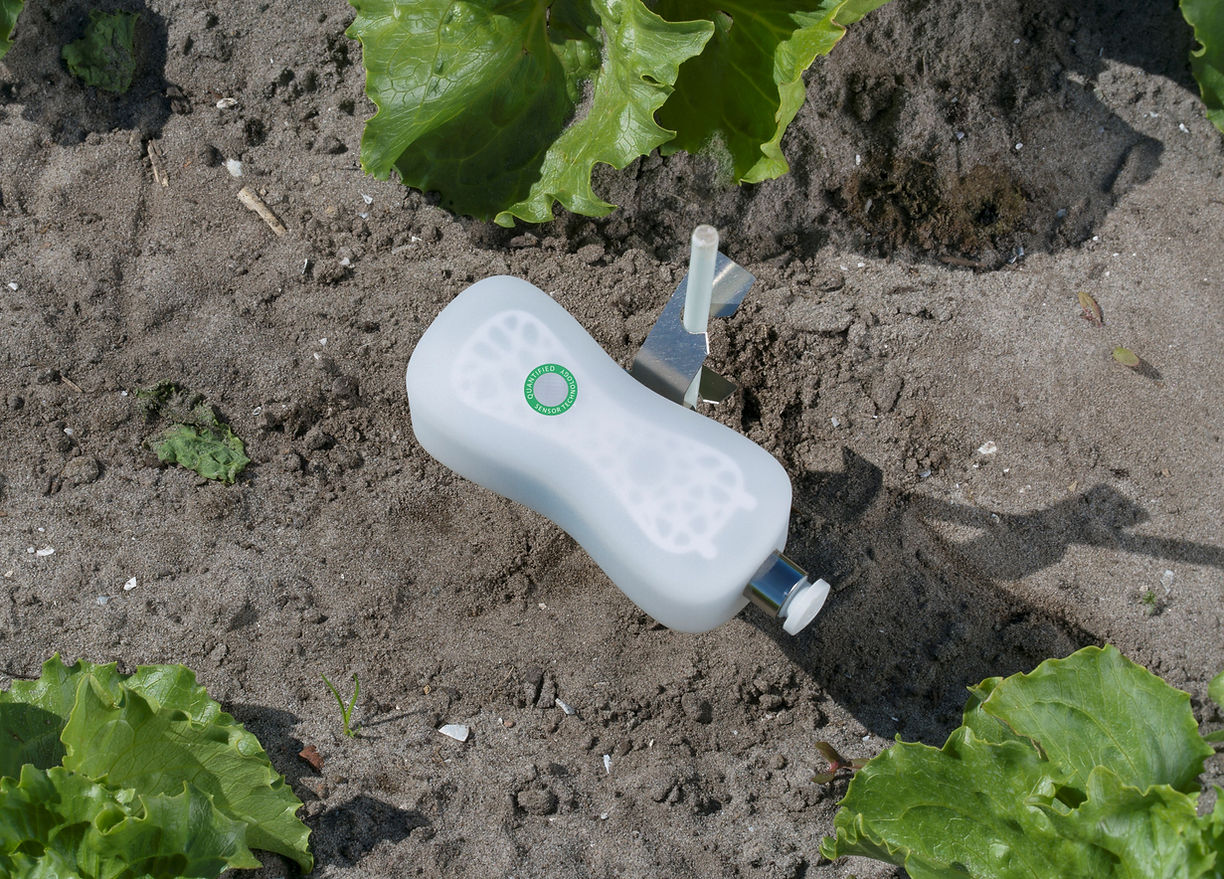
Quantified sensors gauge wind speeds, precipitation, temperature, relative humidity, light, soil moisture and temperature, and EC. A special feature of this sensor concept is that a single sensor measures multiple parameters.
Crucial here: the FireFly, an organically designed Internet of Things device that houses basic measurements and a transmitter module. “The FireFly also has a GPS module,” says Warner, one of Quantified’s founders. “It uses that to transmit its location to the user. For more specific measurements, you can link various external sensors to the Firefly via the connector. The measurement system is wireless, flexible, and easy to scale up.”
Bejo does not only use Quantified sensors. “One of the great things about Quantified is they can add any kind of sensor to their system,” Youri says. “If suppliers are okay with that, of course.” The breeding company is using more sensors. Initially tested in the Netherlands, it now has sensors in the United States, Australia, and other European locations.
A sensor in a carrot field in Tasmania last season
In-depth analysis
Was Bejo working a lot with sensors before moving to Quantified sensors? “Growers we work with gathered data from, for example, weather stations in the field, but otherwise, we had much less data. Nowadays, we have insight into far more data,” Youri explains. Before, Bejo mainly had access to the data the growers sent. “Now that we also measure and have much more data, we can make deeper analyses at a higher level.”
Quantified sensors communicate via a LoRa network. That lets the sensor company choose its own network per location. “LoRa communicates small packets of data over long distances with minimal energy consumption. That suits microclimate measurement well. The FireFly sensors send a short message every five minutes and then go back to sleep. That allows for a year’s worth of measuring with a relatively small rechargeable battery,” Warner explains.
“Successful open field communication over many kilometers is possible. In practice, depending on obstacles between FireFly and the gateway, you can achieve distances of hundreds of meters to a few kilometers. Installing the gateway’s antenna high above the ground helps tremendously. A single gateway can handle data from up to about 100 FireFlies. You can add a gateway for larger sensor networks in built-up environments or critical business processes.”
Archive image of a Quantified sensor
Self visualization
The data all comes into the Netherlands, so the breeding company is building a team of experts. It was important to Bejo that Quantified allows easy data export wherever the customer wants. In the breeding company’s case, to its system. “If we only wanted to see live data from the sensors, logging into Quantified’s system would be sufficient. But we want to do more; we want to use that data. And also link other data from other sources,” Youri continues.
Robbert-Jan Seeleman, Global Seed Production Researcher at Bejo, is involved in this project. “We’re currently in the process of visualizing the data as well as possible. Also, we’re getting acquainted with different data types.” This season, for the first time, the sensors will run for a whole year in the entire seed production process. “Once the seeds are harvested, we can start drawing comparisons and analyze, say, seed quality in relation to climate data,” he says.
Alarms
Bejo can pass along the data it gathers from seed cultivation when delivering the final seeds. For example, seeds grown in a tropical climate prefer regerminating in similar climates. Yet that is not the main reason for using sensors. “With the data we collect, we maintain a good overview of the cultivation’s development and progress.”
“We also see when deviations or problems arise. You can set up alarms for that. We, or the relevant seed production partner, can thus make quicker, more careful adjustments,” says Robbert-Jan. For instance, if the data indicates a disease or pest threat.
Archive image of a Quantified sensor
Steering
This improved data and measurement density comes in handy when weather extremes occur. It is also useful for things that can be controlled, such as greenhouse climate in R&D. “For example, there are differences between crops with more leaf volume or less like onions and leeks.” says Youri. “More leaves naturally allow for more evaporation. Crops without a lot of leaves have less gross evaporation. With knowledge about temperature and humidity, you can positively control evaporation.”
Here, Bejo is taking steps in open-field cultivation, too, with more uniform data. “We prepare and send out sensor kits, often by mail. We advise starting first with a few locations per country and seeing how that goes,” says Youri. That approach is going well. Bejo has now been working with Quantified’s sensors for two years, the last 18 months, worldwide. “We and our team in the Netherlands are proud of that,” Warner concludes.
Om de beste ervaringen te bieden, gebruiken wij technologieën zoals cookies om informatie over je apparaat op te slaan en/of te raadplegen. Door in te stemmen met deze technologieën kunnen wij gegevens zoals surfgedrag of unieke ID's op deze site verwerken. Als je geen toestemming geeft of uw toestemming intrekt, kan dit een nadelige invloed hebben op bepaalde functies en mogelijkheden.
Functioneel
Always active
De technische opslag of toegang is strikt noodzakelijk voor het legitieme doel het gebruik mogelijk te maken van een specifieke dienst waarom de abonnee of gebruiker uitdrukkelijk heeft gevraagd, of met als enig doel de uitvoering van de transmissie van een communicatie over een elektronisch communicatienetwerk.
Voorkeuren
De technische opslag of toegang is noodzakelijk voor het legitieme doel voorkeuren op te slaan die niet door de abonnee of gebruiker zijn aangevraagd.
Statistieken
De technische opslag of toegang die uitsluitend voor statistische doeleinden wordt gebruikt.De technische opslag of toegang die uitsluitend wordt gebruikt voor anonieme statistische doeleinden. Zonder dagvaarding, vrijwillige naleving door je Internet Service Provider, of aanvullende gegevens van een derde partij, kan informatie die alleen voor dit doel wordt opgeslagen of opgehaald gewoonlijk niet worden gebruikt om je te identificeren.
Marketing
De technische opslag of toegang is nodig om gebruikersprofielen op te stellen voor het verzenden van reclame, of om de gebruiker op een site of over verschillende sites te volgen voor soortgelijke marketingdoeleinden.
Bosch Growers grows bell peppers and soft fruits (blackberries and strawberries) across operations in the Netherlands and the United States. In daily cultivation, reliable data plays a central role in understanding greenhouse conditions and enabling timely decisions. For Erwin de Bruijn, Cultivation Manager at Bosch Growers, Quantified has become an integral part of his daily routine.
Quantified Sensor Technology’s wireless sensor systems can now be directly integrated with Priva One, one of the most widely used climate computer platforms. The announcement allows growers worldwide to seamlessly enrich their Priva environments with detailed, real-time data on microclimate and substrate conditions, ultimately saving time, water, nutrients, and labour.
During a visit to Koppert Cress’ production site in Monster, The Netherlands, we spoke with Bart van Meurs about Quantified sensors in both production and research. It’s always inspiring to see the enormous variety of innovative products grown by this unique company! Below a short impression of the discussion with Bart.