How Schenkeveld improves EC management through early drainage detection
At Schenkeveld, precision is essential. With over 100 hectares of greenhouse in the Netherlands and Morocco, the company manages high-value crops. Effective fertigation and monitoring drainage are key for successful operation. Schenkeveld is a member of the Growers United cooperative.
Grower and Site Manager Leon van der Zalm oversees plum tomato cultivation at location ‘t Zweth in The Netherlands. His team uses an IIVO climate computer to program fertigation strategies. Actual values of EC and pH, at the plant level, are crucial parameters in selecting the appropriate strategy.
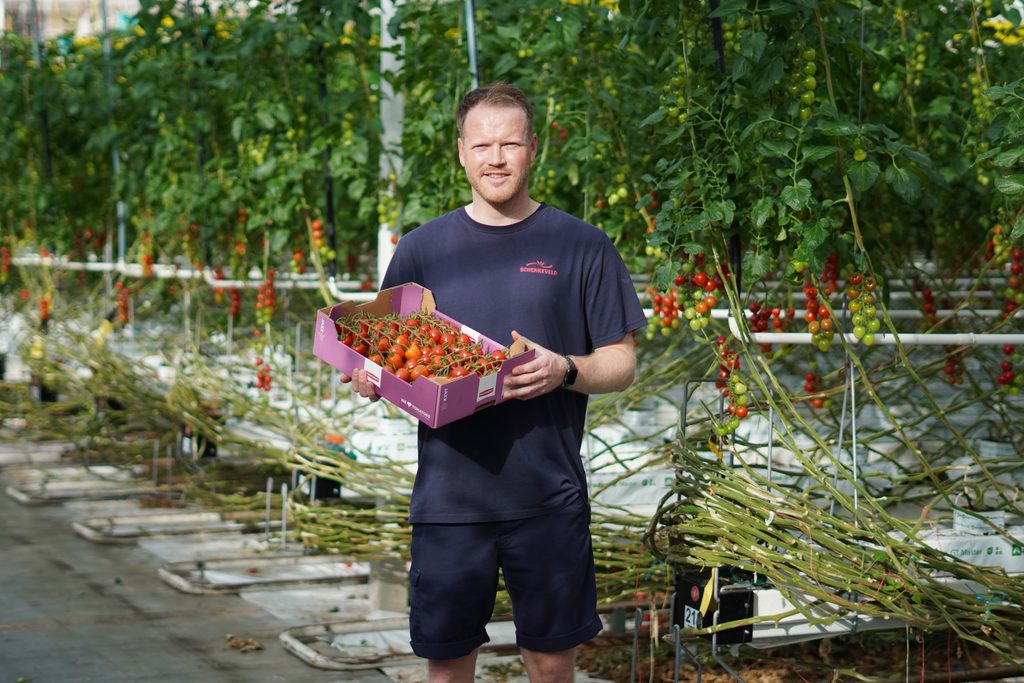
Measuring actual drainage values
Before working with Quantified, Schenkeveld monitored EC and pH through measurements in the drainage collection pit and with a Grodan handheld meter. While these measurements remain valuable, the team indicated that a continuous data stream on fertigation and drain would be highly beneficial, in particular it would enable them to observe trends throughout the day.
Around a year and a half ago Joost Barendse, the Head Grower at Schenkeveld Group introduced Quantified sensors at the ‘t Zweth location. The team was looking for a way to verify whether the conditions in the greenhouse matched the expected values, given climate computer settings.
This is when the Quantified DrainXXL sensors were installed. Where Quantified’s conventional drain sensors work with millilitre samples, the DrainXXL provides real-time insight into drainage and fertigation from the entire gutter. The DrainXXL data is fully integrated with IIVO. This meant there was no learning curve for the team, as information was added to the daily cultivation management system.
The benefits of measuring earlier
With DrainXXL, Schenkeveld now detects the first drainage approximately 30 minutes earlier than through the conventional drainage collection pit.
As Leon explains:
“Especially during the summer with warm weather, it’s important to be able to flush the substrate in a timely manner and prevent the EC level from rising too high. At such times, you want to know exactly what is happening and whether your fertigation strategy is well-aligned with the current conditions.”
With these additional measurements, Leon and his team receive an early warning when fertigation and drainage don’t behave as expected. This enables them to take swift and appropriate action.
Risk management in high-value crops
For Leon, another reason to use Quantified’s sensors is to manage risks. Given the size of the operation and the high value of the crops, even relatively small deviations can have big consequences. By closing the loop with additional sensors, they validate the outcome of climate computer settings.
As he explains:
“For us, it’s primarily a matter of risk management. We configure our climate computer in a specific way, but naturally, you want to know whether those settings are actually executed in practice.”
By providing earlier insight into drainage performance, Quantified helps Schenkeveld to verify whether the settings programmed into its climate computer have the intended effect. The additional information provides certainty in daily cultivation decisions.
Optimising water use for the future
Leon foresees that efficient water management will become increasingly important for growers, even in the Westland.
As he highlights:
“We need to use water sparingly and optimise drainage. Water is becoming more expensive and scarcer.”
Leon also points out that the anticipated restrictions on groundwater extraction towards 2030 will present another challenge for the sector. As the regulations on water become more stringent, reliable information about drainage performance will become essential: optimising drainage is one of the crucial steps required to make efficient use of this scarce resource.
Leon’s advice to other growers
When asked for which application he would recommend growers to use Quantified sensors, Leon mentions the importance of knowing whether actual conditions match expectations.
“You want to know that you’re on the right track and that the actual situation aligns with what you expected based on your settings. This additional layer of oversight provides confidence and helps to mitigate risks.”
He also emphasises the importance of reliability and ease of use:
“In a greenhouse environment, it simply needs to work reliably, without requiring constant attention. That is exactly what Quantified delivers.”
A reliable solution for daily cultivation
When asked to describe Quantified in just a few words, he summarises his experience:
“Always available, good service. Very simple, foolproof, works perfectly. The integration with IIVO also works well.”
Interested in how Quantified’s wireless sensors could support your cultivation? Contact us at [email protected]!